Country readiness
Which AMR entry points are ready?
Identify which priorities are supported by current capabilities, institutions, programmes and evidence.
AMR AgentBrain reconstructs the evidence behind a live country, programme or portfolio decision.
We connect national priorities, surveillance, development finance, procurement, implementation and results while preserving what is directly supported, what is only inferred and what still requires verification.
A country may have a national action plan. A development programme may strengthen laboratories, surveillance, health systems, agriculture or WASH. A donor may finance an intervention. An implementer may report activities. A researcher may publish a resistance signal.
But for the next appraisal, portfolio review, funding decision or evaluation, the operational questions remain difficult to answer from public evidence alone.
Which priorities are actually financed?
Which investments are genuinely attributable to AMR?
What has been implemented?
What evidence exists after delivery?
What changed - and what remains unproven?



AgentBrain keeps the operating context visible: where a record came from, what it establishes and where it cannot support a stronger conclusion.
Identify which priorities are supported by current capabilities, institutions, programmes and evidence.
Map what is already financed, where investments overlap and where a real gap remains visible.
Test whether a financing commitment connects to procurement, implementation, outputs and observable results.
Show what evidence supports the proposed intervention and where the appraisal still depends on an unresolved claim.
Separate planned work, delivered work, observed change and unsupported outcome attribution.
Receive short notes on AMR financing, attribution and implementation traceability when a public finding changes the decision frame.
Bring one country, programme or portfolio question. Within five working days, receive a bounded, source-anchored evidence package designed for a real institutional decision.
The exact question, geography, period, decision owner and review boundary.
Relevant priorities, capabilities, programmes, institutions and current evidence.
Projects, funders, recipients, implementation routes and financing signals.
Each investment is classified without converting relevance into unsupported attribution.
Procurement, implementer, delivery, output and outcome evidence where available.
Unresolved claims are preserved, not filled with assumptions.
A specific record, source or institutional confirmation to pursue next.
A focused review of findings, limits and available next steps.
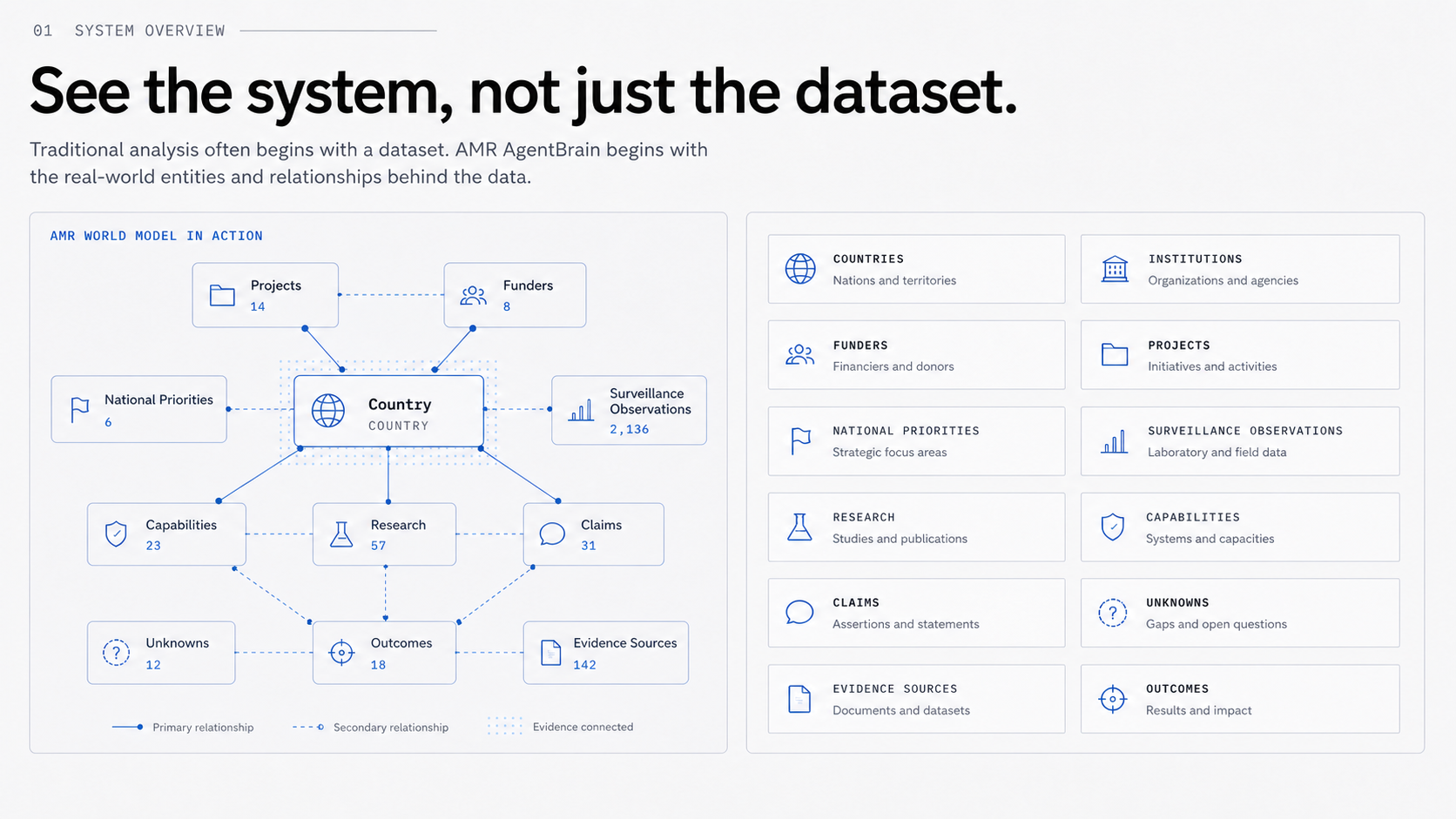
Small enough to review. Concrete enough to prove value. Useful even when the answer is that the evidence does not yet support the claim.
AMR AgentBrain connects public evidence across policy, surveillance, financing, research and implementation into a common analytical structure.
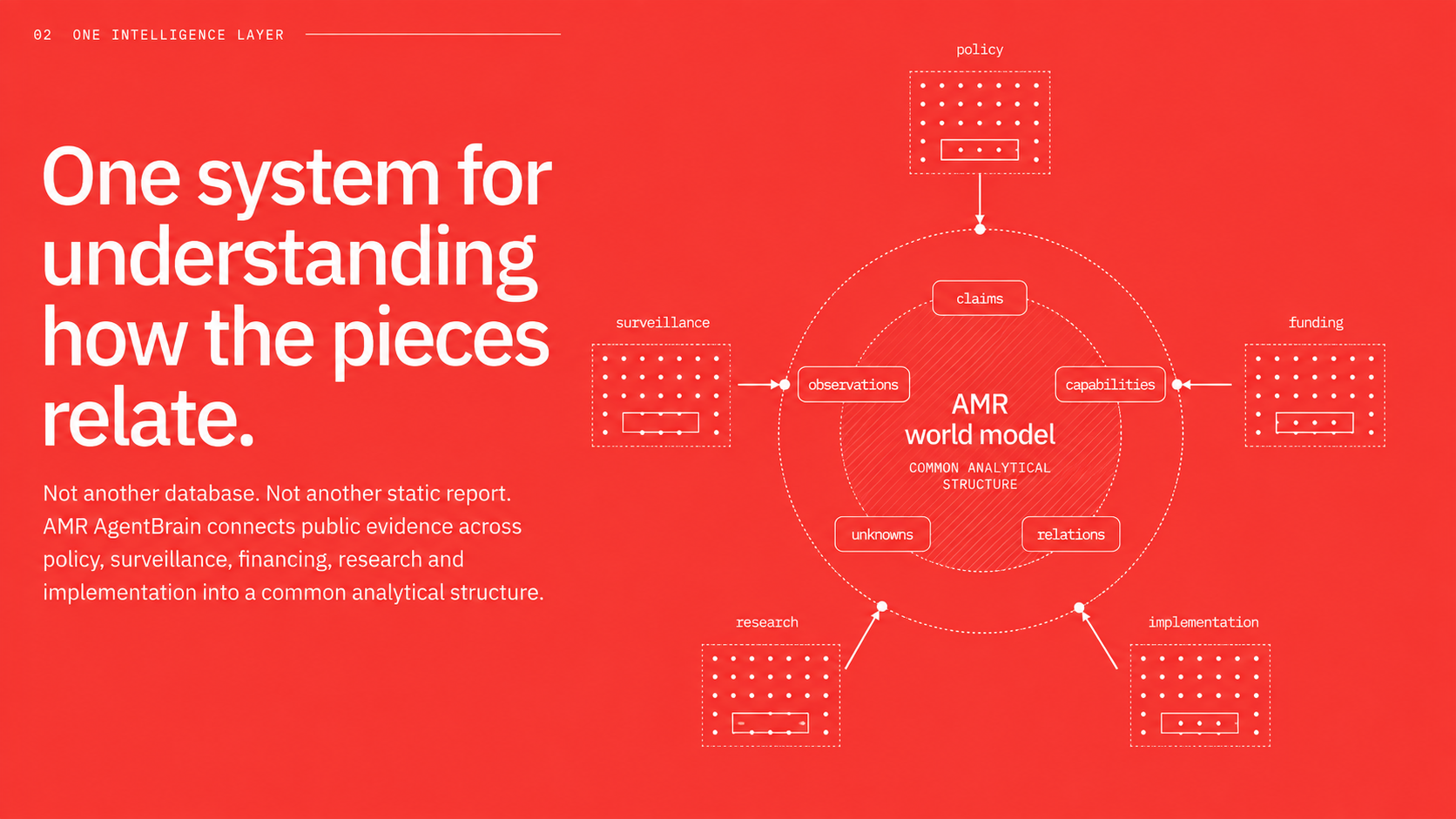
Support country appraisal, portfolio analysis, implementation readiness and results review.
See additionality, overlap, delivery evidence and unresolved portfolio gaps.
Reduce evidence reconstruction inside bids, evaluations and country assignments.
Connect national priorities with ownership, budgeting, implementation and monitoring evidence.
Which existing operations already support AMR-relevant capacity? Where are the strongest implementation entry points? Which assumptions require verification before investment or scale-up?
A source-anchored country or portfolio evidence pack that your team can inspect, challenge and reuse in internal review, appraisal or evaluation work.
Health-system, laboratory, agriculture, WASH and One Health investments may support AMR objectives. That does not mean the entire programme or financing envelope can be attributed to AMR.
AMR is an explicit objective, activity or funded component.
The intervention strengthens a capability relevant to AMR, but the full financing is not AMR-specific.
The programme may affect the surrounding environment, but no defensible AMR connection has yet been established.
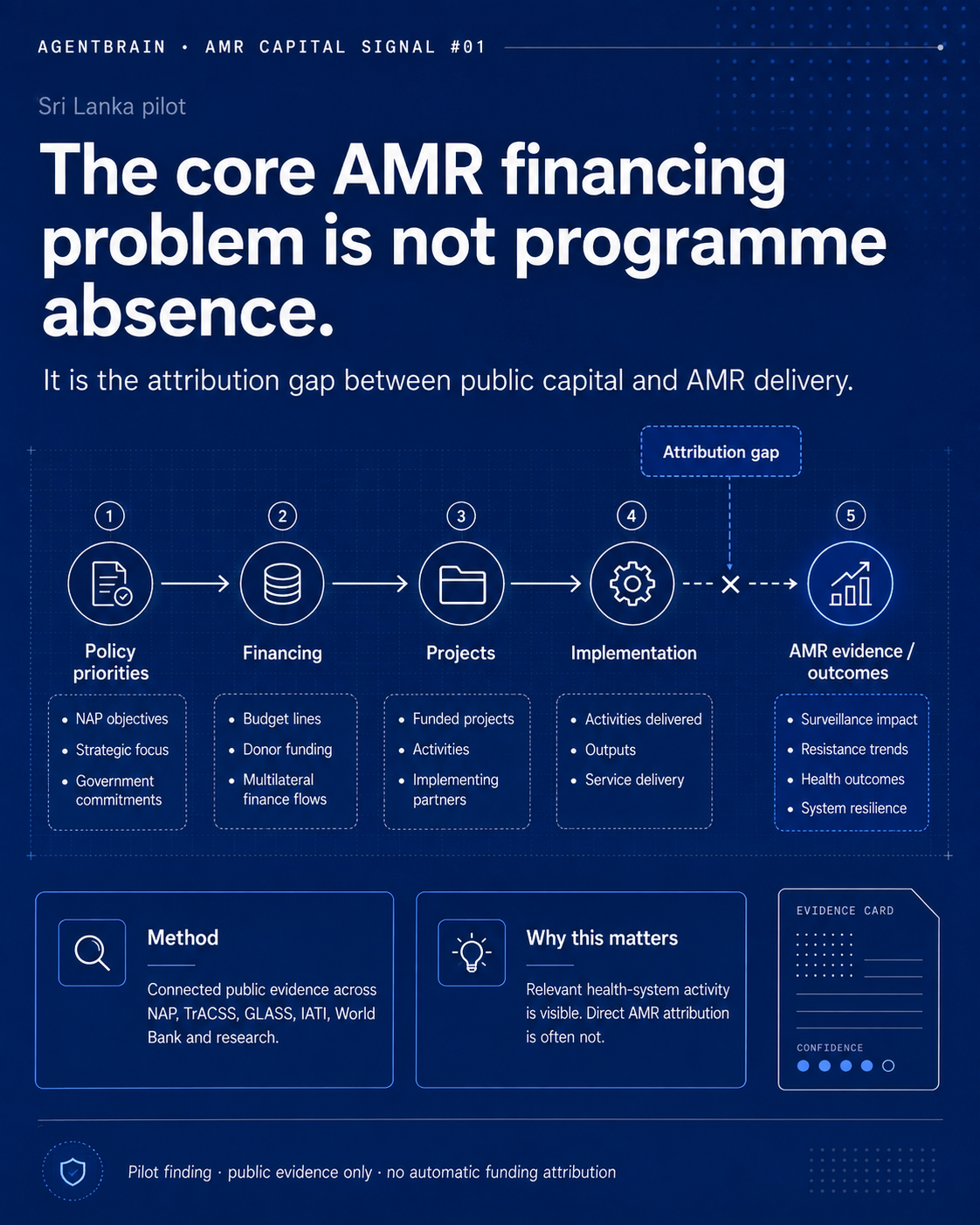
Example finding: public capital can be visible while AMR attribution remains unresolved.
For each programme or project, the evidence chain tests what can legitimately be connected, and where the public chain stops.
Version, locator, date and scope remain attached.
What the record actually establishes.
The strength of the relationship being used.
Claims can be downgraded when the source does not hold.
Where review effort should go next.
For readers tracking AMR capital, execution evidence and public traceability across country and portfolio work.
Alpha can search sources, compare records, identify possible relationships, surface contradictions and propose evidence updates. It cannot silently promote a weak connection into a verified claim.
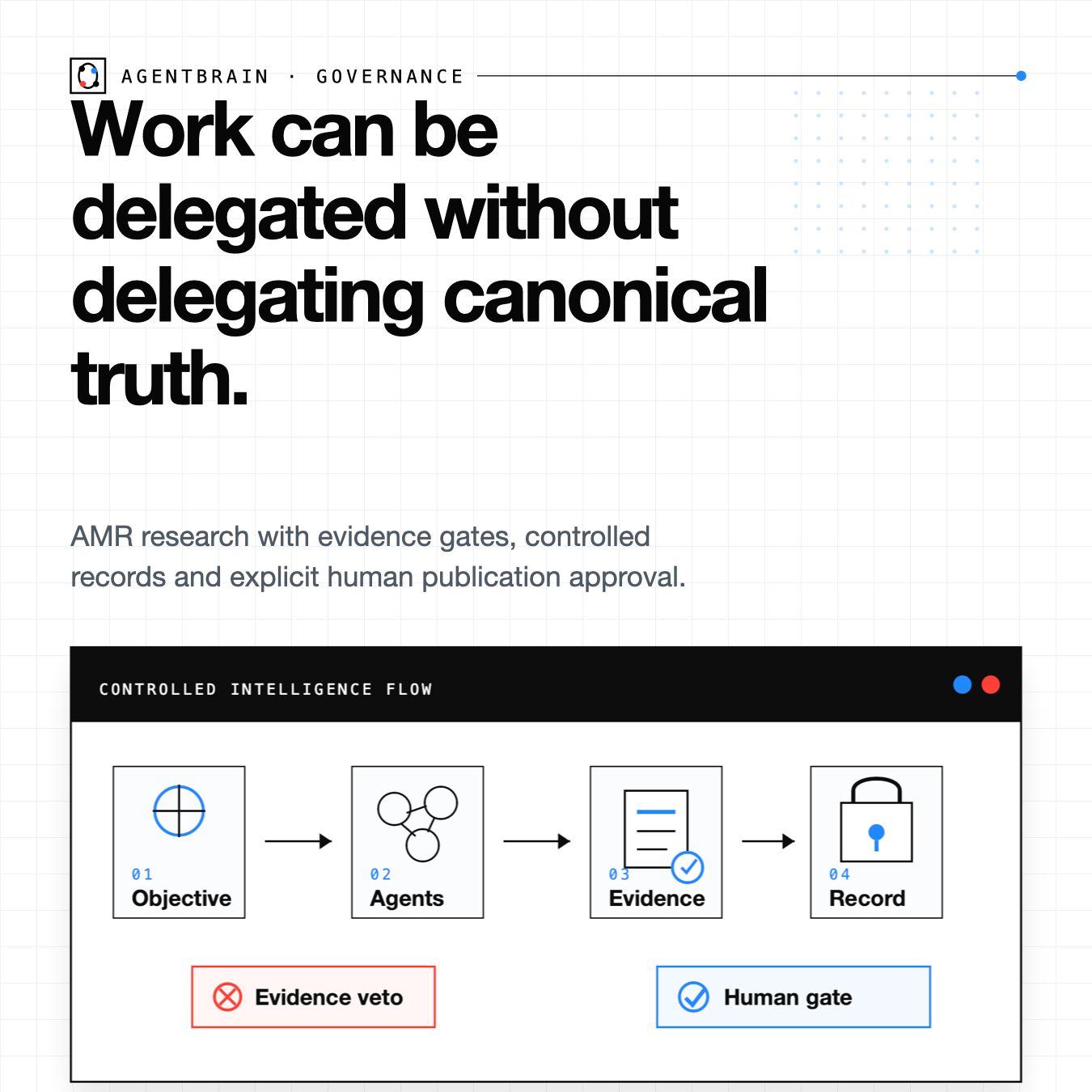
Alpha can accelerate evidence work, but review gates determine what becomes reusable institutional knowledge.
The sample brief shows how AMR evidence moves from source review into a decision-oriented account: what is supported, what is not supported and what would change the answer.
Open sample evidence briefHow AgentBrain delegates AI work without delegating canonical truth.
Short, source-bound notes on AMR capital, attribution gaps, implementation traceability and evidence breaks. Written for readers who need the caveat as much as the conclusion.
Bring a country question, portfolio question, funding or additionality question, implementation gap or evaluation that needs a defensible evidence base.
We will show what the reviewed evidence supports, what it does not support and what would change the answer.