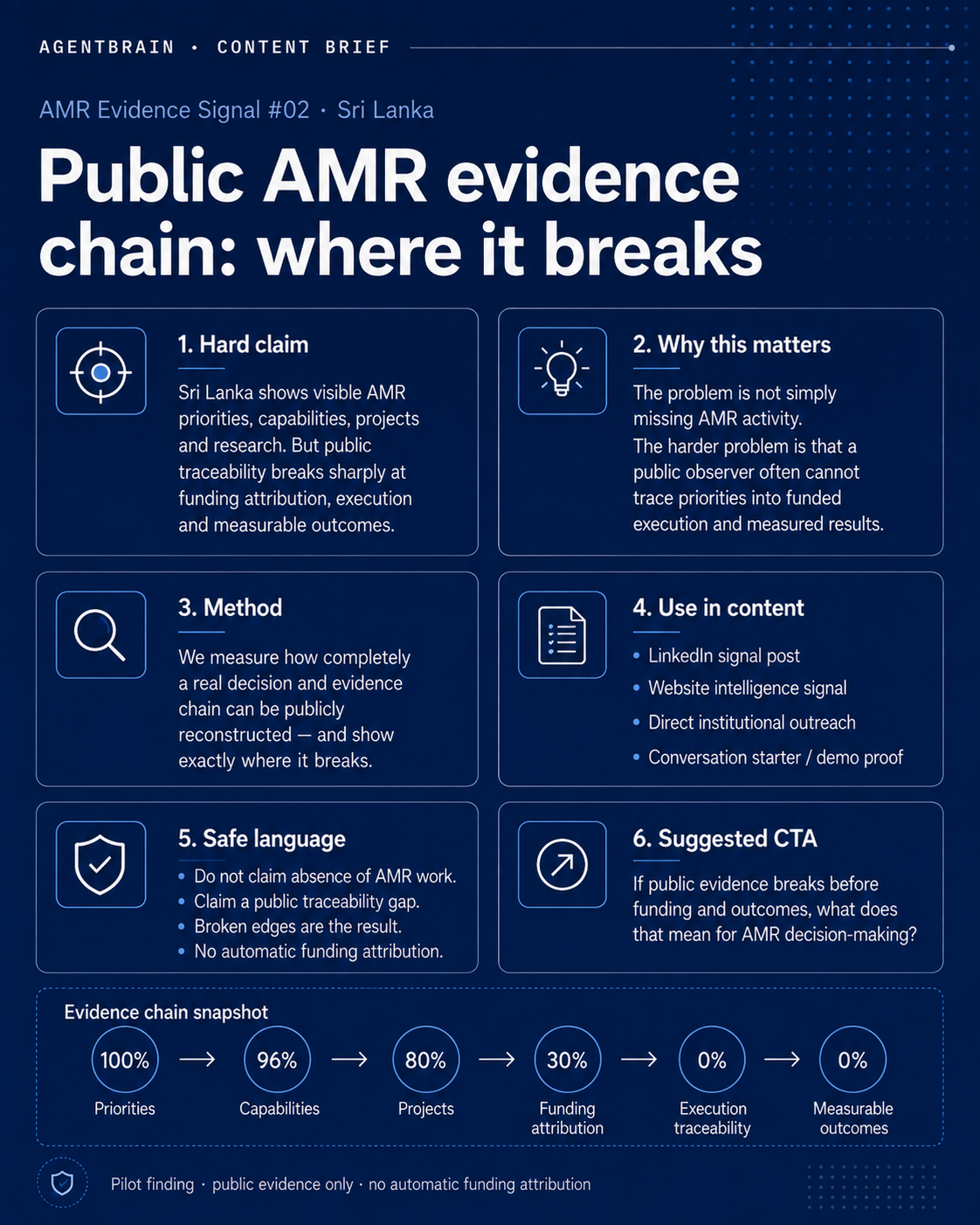
A country can have an antimicrobial resistance strategy. It can report surveillance capacity. It can show AMR capabilities, donor programmes, health-system investments and published research.
An external observer may still be unable to answer a much more basic decision question: which priority was financed, what was actually executed, and what measurable result followed?
The hard claim.
In the current AgentBrain Sri Lanka pilot, AMR priorities, capabilities, projects and research are publicly observable. But the evidence chain becomes sharply less reconstructable when moving into funding attribution, execution and measurable outcomes.
A broken evidence relationship does not mean that financing did not occur. It does not mean an activity was not implemented. It means something narrower: the relationship could not be established to the required standard from the public evidence reviewed in the current model.
What we measured.
Rather than asking only whether individual datasets existed, the pilot attempted to reconstruct relationships between evidence objects.
National Action Plan and strategic priorities.
Reported AMR capabilities and implementation maturity.
Publicly observable project, programme or claim evidence.
Defensible attribution of capital to an AMR priority or activity.
Evidence that a specific activity was delivered.
Measurable AMR result with defensible relationship to the activity.
Sri Lanka's National Strategic Plan for Combating Antimicrobial Resistance 2023-2028 provides the policy layer. WHO's AMR data environment includes country-profile and TrACSS information, and WHO's GLASS architecture provides standardized AMR surveillance information at global, regional and national levels. The data environment is not empty. The harder question is whether the relationships between those objects can be defended.
Evidence-chain snapshot.
These percentages are not national AMR performance scores. They are not WHO indicators. They describe public traceability inside the current AgentBrain pilot and its present evidence inventory.
Where the chain begins strongly.
At the upstream end, the evidence environment is comparatively clear. Sri Lanka's National Strategic Plan provides a formal framework for AMR priorities and planned actions. Within the pilot extraction, national priorities can therefore be represented with high visibility.
The capability layer is also comparatively strong. TrACSS and WHO AMR profile information provide structured evidence about reported AMR capabilities and implementation maturity. That does not mean 96% implementation. It means the working model could identify public relationships between represented priorities and corresponding capability evidence.
Where visibility starts to weaken.
Sri Lanka also has identifiable projects and health-system investments related to areas relevant to AMR. A recent example is the World Bank-documented Strengthening One Health Laboratory Systems in Sri Lanka for Health Emergency Preparedness, P510192, which sits in the One Health, health-security and laboratory-systems environment.
This is where attribution discipline becomes important. A health-system programme can be highly relevant to AMR. That does not automatically mean its entire financing envelope can be attributed to AMR.
Three statements are often confused: a project exists; a project contains activities relevant to AMR; and a defined amount of capital can defensibly be attributed to a specific AMR priority or activity. Those are not equivalent propositions.
The major break: funding to execution.
The chain becomes still more difficult after financing. The central question becomes whether identified capital can be connected to evidence that a specific AMR activity was actually delivered.
For the analysed funding relationships, the pilot has not yet reconstructed a complete public chain of specific capital -> specific AMR activity -> verified execution evidence at the standard required for a closed edge.
That is not evidence of zero implementation. It is a traceability result. Sri Lanka reports multiple AMR capabilities and identifiable projects contain implementation activity. The problem is stricter: the public evidence represented in the pilot does not yet close the funding-to-execution edge.
Outcome attribution is harder again.
Suppose a laboratory programme is financed, capability improves and surveillance expands. Can the analyst then conclude that the investment caused a change in AMR resistance? Usually not.
The resistance observation must be country-specific and appropriately scoped. The implementation must precede the outcome. The intervention must plausibly affect the measured indicator. Confounding factors have to be considered. Most importantly, an observed association must not silently become a causal claim.
In the current working model, funding to measurable AMR outcome has 0% closed edges. That is not evidence of zero impact. It means the causal or attribution chain cannot currently be established from the public evidence represented in the pilot.
Regional is not national.
The same discipline applies to resistance observations. WHO GLASS increasingly provides global, regional and national surveillance information, and WHO explicitly treats completeness and representativeness as important dimensions of national AMR data.
Regional observations may help describe the broader epidemiological environment. But a regional estimate cannot automatically be converted into a Sri Lankan national observation. Regional evidence remains regional. Country evidence remains country evidence.
The deeper finding: AMR has an edge problem.
Most conventional data systems organize information as objects: a plan, a project, a grant, a capability, a surveillance observation, a paper.
Institutional decisions depend heavily on the edges between those objects. Did this project finance this priority? Did this funding result in this activity? Did this activity produce this output? Did this capability change this outcome?
The presence of two adjacent pieces of evidence does not prove that the relationship between them exists. The question is not only what evidence exists. It is which relationships between evidence objects can actually be defended.
Evidence ledger.
Sri Lanka National Strategic Plan 2023-2028
National AMR priorities and planned activities.
Financing or completed execution.
Verified
WHO TrACSS / AMR Country Profile
Reported AMR capabilities and implementation maturity.
Independent verification of every underlying activity.
Verified at source level
WHO GLASS
Surveillance evidence within reported scope.
That every required national observation exists or is representative.
Verified at source level
Public project records
Existence and scope of relevant programmes.
Full AMR attribution of project value.
Attribution separate
AgentBrain reconstruction
Visibility of relationships between evidence objects.
National AMR performance.
Pilot result
What this finding does and does not say.
The pilot supports this conclusion: Sri Lanka's public AMR evidence environment is more visible upstream than downstream. Policy priorities, capabilities and relevant projects can often be identified, while defensible public reconstruction becomes substantially weaker around funding attribution, execution and measurable outcomes.
It does not support claims that Sri Lanka lacks AMR activity, lacks AMR financing, has no resistance data, or executed 0% of AMR funding. Those would be different claims requiring different evidence.
The evidence chain is strongest upstream. The major break occurs downstream.
A broken edge means not established from the reviewed public evidence. It does not mean does not exist.
Receive future AMR Signals.
Short, source-bound notes on AMR capital, attribution gaps, implementation traceability and evidence breaks. Enter your email and we will add you to the AMR Signals list.
Primary public sources
WHO · Sri Lanka National Strategic Plan for Combating Antimicrobial Resistance 2023-2028 WHO · AMR Data Portal WHO · AMR Country Profile / TrACSS data environment WHO · Global Antimicrobial Resistance and Use Surveillance System WHO · Updated GLASS dashboard for antimicrobial resistance and use World Bank · Strengthening One Health Laboratory Systems in Sri Lanka for Health Emergency Preparedness - P510192Need a public evidence chain tested?
Bring the country, programme or AMR decision question. AgentBrain separates visible evidence, defensible relationships and unresolved edges before a conclusion becomes a decision input.
Request Evidence Review